October 24, 2026 · 5 min read
How to Evaluate Backlink Quality Before You Build a Link
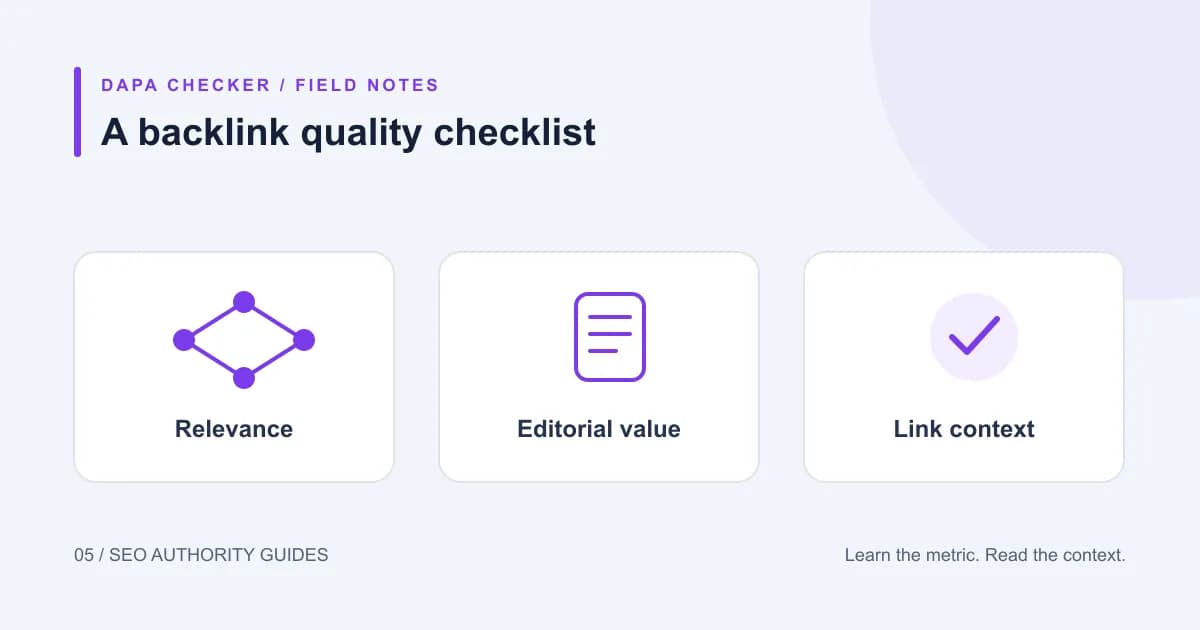
Backlink quality is how much a link from another website is likely to help your site rank and send visitors. A high-quality backlink comes from a relevant, trusted site with real traffic, sits on a page people read and links to you naturally from within the content.
Authority scores are only one part of that. A DA 70 site with no traffic and a page full of paid links can be worth less than a DA 25 blog that your exact customers read. Here's how to tell the difference before you spend time or money on a link.
What makes a backlink high quality
A high-quality backlink has 5 traits. The more of them a link has, the more it's likely to help.
- Relevance. The linking site covers the same topic or audience as you.
- Authority. The site and page have earned links of their own.
- Real traffic. People find and read the site through search.
- Editorial placement. The link sits inside the main content, where a writer chose to include it.
- Clean history. The site isn't part of a link network and doesn't sell links to anyone who pays.
Visual guide
Look beyond the number
Topic fit
Does the source page cover a subject relevant to your audience?
Real readership
Check content quality and whether the site attracts real visitors.
Link placement
Review editorial context, destination and link attributes.
How to evaluate backlink quality step by step
Run every link prospect through these 6 checks. The first 3 take under a minute.
- Check topical relevance. Read the homepage and 3 recent posts. Would your customers read this site? If the topics jump from casinos to CBD to car insurance, walk away.
- Check authority. Run the domain through our DA PA checker. Note DA and DR together. A big gap between them (for example DA 45 and DR 5) is a sign to look closer.
- Check Spam Score. Moz Spam Score above 30% means the site shares features with sites Google has penalized. Read our explainer on what Spam Score means before ruling a site out.
- Check organic traffic. Use any SEO tool with traffic estimates. A site with high authority and close to zero search traffic is a common sign of a link farm or an expired domain rebuilt to sell links.
- Check the specific page. Look at the Page Authority of the URL where your link will appear. A brand-new guest post page starts with almost no links of its own. Our guide to DA vs PA vs DR explains why the page matters.
- Check outbound links. Scroll the page. If every post links out to 5 unrelated commercial sites, the site is selling links, and Google can discount all of them.
Red flags of a low-quality backlink
Any one of these is a reason to pause. Two or more is a reason to say no.
- A "write for us" page with a price list and no editorial standards.
- Posts on every topic, all published in the last few months.
- Authority over 40 with almost no organic traffic.
- Spun or machine-written articles with awkward, repetitive wording.
- Many outbound links in each post, often to gambling, pharma or loan sites.
- A domain that used to be a different business, visible in the Wayback Machine.
- Sitewide footer or sidebar links sold to many unrelated companies.
Dofollow vs nofollow, sponsored and UGC links
A dofollow link is a normal link with no rel attribute that limits it. Nofollow, sponsored and UGC links carry a rel attribute that tells Google how the link relates to the page.
- rel="sponsored" marks paid or advertising links.
- rel="ugc" marks links in user content such as comments and forum posts.
- rel="nofollow" is the general option when the site doesn't want to vouch for the link.
Google treats these attributes as hints, according to its guide on qualifying outbound links. A nofollow link from a relevant, busy site can still send real visitors and lead to other links. Don't reject a strong site only because its links are nofollow.
Authority metrics vs real-world value
Authority metrics estimate link strength, while real-world value is about relevance, traffic and trust. You need both to judge a link.
Example: a DA 28 local business association in your city links to its members. It has 300 monthly visitors, all local. For a local service business, that link is a better use of time than a DA 60 general guest post site with thousands of sponsored articles.
Use DA and DR to filter, then decide with the checks above. When you screen a long list, the bulk domain authority checker scores up to 100 domains at once.
Why backlink quality matters
Backlink quality matters because Google rewards links that are earned and ignores or penalizes links built to manipulate rankings. Google's link spam policy lists buying links, excessive link exchanges and automated link building as violations.
Low-quality links waste budget at best. At worst they add risk to a site you've spent years building. A short list of strong, relevant links usually beats a long list of weak ones, for rankings and for your Domain Authority.
Frequently asked questions
What is a good DA for a backlink?
There's no fixed minimum. A relevant site with real traffic and DA 20 or above is usually worth pursuing, especially in small niches.
Are nofollow backlinks worthless?
No. Google treats nofollow as a hint, and nofollow links from relevant sites can send visitors and lead to other links.
How many backlinks do I need?
It depends on your competitors. Compare your referring domains with the sites ranking above you and aim to close that gap with relevant links.
Can bad backlinks hurt my site?
Google mostly ignores spammy links it detects. Deliberate link schemes can lead to a manual action, which you'd see in Search Console.
Conclusion
Backlink quality comes from relevance, real traffic, editorial placement and a clean history, with authority scores as a quick first filter.
Check DA, DR and Spam Score in seconds, then spend a few more minutes on traffic and outbound links before saying yes.