October 24, 2026 · 5 min read
Why Did My Domain Authority Drop? 8 Causes and What to Do
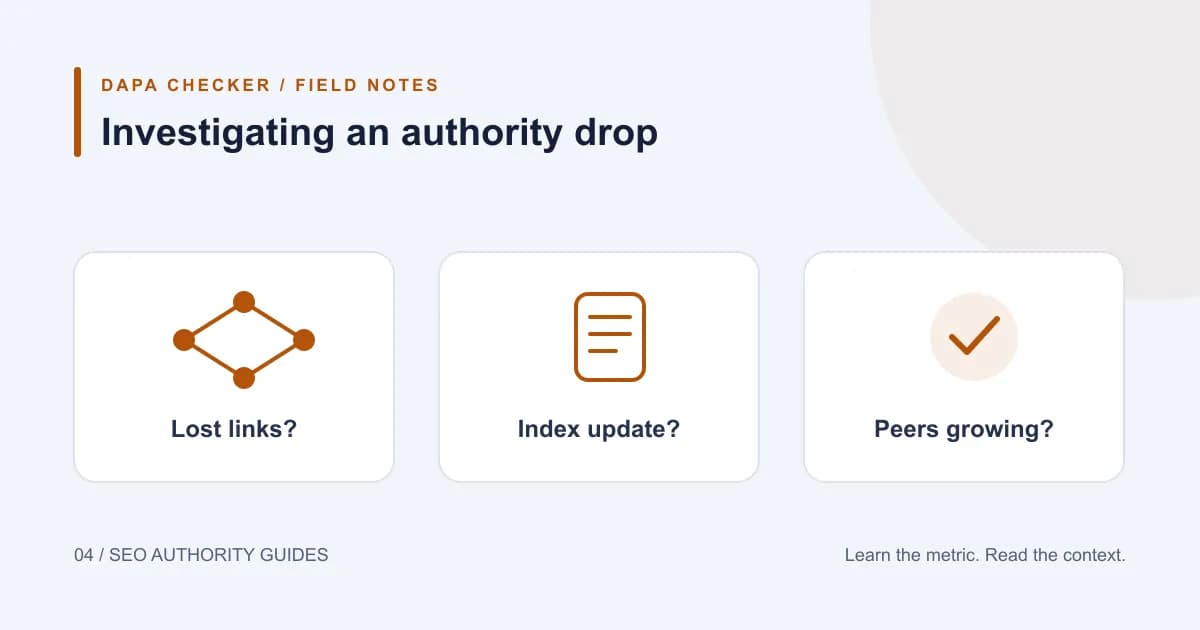
If your Domain Authority dropped, the most likely causes are lost backlinks, a Moz index or model update, or competitors gaining links faster than you. A Domain Authority drop is a change in a third-party score. It does not mean Google has penalized your site.
Start by checking whether your traffic and rankings also fell. If they didn't, the drop is almost always about how Moz sees your links, and you have time to investigate calmly.
Why Domain Authority drops: the short answer
Domain Authority drops when Moz's model rates your link profile lower relative to other sites. That can happen because you lost links, because other sites got stronger, or because Moz changed how it measures.
DA is relative and logarithmic. Your score depends on everyone else in the index, so a flat link profile can still slip by 1 to 3 points over a few months. Our guide to what Domain Authority measures explains the model behind this.
8 common causes of a Domain Authority drop
1. You lost backlinks
Lost links are the most common cause. Pages that linked to you get deleted, sites expire, or editors remove old links during a cleanup. Losing 5 links from 5 strong domains can move DA more than gaining 20 weak ones.
2. Moz updated its index or model
Moz refreshes its link index regularly and occasionally retrains the DA model. When that happens, scores shift across the web at once. If many sites in your niche dropped in the same week, this is the likely reason.
3. Competitors grew faster
DA compares you with every other domain. If the top sites gained links quickly, the scale stretches and your position on it can slip, even with no lost links.
4. Spammy links were devalued
Moz's model discounts links that look manipulative. If part of your DA came from a link network or bought links, those can stop counting, and the score falls back to what your real links support.
5. A site migration lost links
Moving to a new domain, switching to HTTPS or changing URL structure without 301 redirects leaves old links pointing at 404 pages. Those links stop passing value to your live pages.
6. Links pointed to the wrong version of your site
If some links go to www and others to non-www, or to http and https separately, and the versions don't redirect to one canonical host, link strength gets split.
7. A big linking site changed
One high-authority site removing a sitewide link, or adding nofollow to its outbound links, can take a noticeable chunk out of a small site's DA.
8. Natural fluctuation
Small sites see more noise. A move of 1 or 2 points on a DA 12 site is usually normal movement, not a signal worth acting on.
Visual guide
Find what changed
Check your links
Look for lost referring domains and broken destination pages.
Check the context
Compare peer scores and look for index or model changes.
Check search results
Review clicks and rankings separately before deciding what to fix.
How to find the cause of a Domain Authority drop
Work through these steps in order. Most drops are explained by step 3.
- Check traffic and rankings first. Open Google Search Console and compare clicks and impressions for the last 3 months. If they're steady, Google hasn't changed how it treats you.
- Check competitors. Run your site and 3 to 5 competitors through the domain comparison tool. If everyone dropped, it was an index update.
- Review lost links. Use a backlink tool's lost links report for the last 60 to 90 days. Note which domains disappeared and how strong they were.
- Check redirects. Crawl your old URLs and confirm each one returns a 301 to a live page, not a 404.
- Check Spam Score. A rise in Spam Score at the same time as a DA drop points to low-quality links being discounted.
Domain Authority drop vs Google ranking drop
A Domain Authority drop is a change in Moz's estimate, while a ranking drop is a change in Google's results. They can happen together, but one doesn't cause the other.
If both fell in the same week, look at Google first. Check Search Console for manual actions and compare the dates with Google's Search Status Dashboard, which lists ranking updates . If only DA fell, your search traffic is unaffected for now, and the fix is about links.
How to recover lost Domain Authority
Match the fix to the cause you found:
- Lost links: contact the site owners. If a page was moved, ask them to update the URL. If your page was moved, redirect the old URL.
- Broken migration: add 301 redirects from every old URL that has links to the closest matching new page.
- Split hosts: pick one canonical version (for example https with no www) and redirect all others to it.
- Devalued spam links: stop buying them. Put the budget into earning links from relevant sites instead.
- Index update or competitor growth: keep building links steadily. Our list of ways to increase Domain Authority is a good plan.
Why a Domain Authority drop matters (and when it doesn't)
A Domain Authority drop matters when it reflects real lost links, because those links also helped your pages rank in Google. Recovering them protects traffic, not just the score.
It matters much less when it comes from an index update. In that case your links are the same, Google sees the same site, and the only thing that changed is Moz's scale. Avoid reacting with rushed link buying.
Frequently asked questions
Is a Domain Authority drop a Google penalty?
No. Domain Authority is a Moz metric, and Google doesn't use it. A DA drop says nothing about penalties unless your Google traffic dropped too.
How much DA drop is normal?
A change of 1 to 3 points is common, especially for sites under DA 30. Larger drops usually have a specific cause, such as lost links or an index update.
How long does it take to recover Domain Authority?
Fixed redirects and reclaimed links can show up in 4 to 8 weeks once Moz recrawls them. Recovering from an index-wide change takes as long as building new links does.
Should I disavow links after a DA drop?
Usually no. Google's disavow tool affects Google only and does not change Moz scores. Google says most sites don't need it.
Conclusion
A Domain Authority drop usually comes from lost links, a Moz update or faster-growing competitors. Check traffic and competitors first, then lost links and redirects.
Fix what you lost, keep earning relevant links and recheck in a month with the free DA PA checker.