Updated October 24, 2026 · 6 min read
What Is Domain Authority (DA)? The Complete 2026 Guide
Domain Authority (DA) is a score from 1 to 100, created by Moz, that predicts how likely a website is to rank in Google compared with other websites. A higher Domain Authority means a stronger backlink profile. The number is a forecast built from link data. Google does not read it or use it.
If you've ever bought a guest post, pitched a client or sized up a competitor, you've probably seen DA quoted as proof of something. This guide covers what the score measures, how Moz calculates it, what counts as a good number and where it falls short.
What Domain Authority measures
Domain Authority measures the strength of a whole domain's backlink profile relative to every other domain in Moz's link index. Moz describes it as a prediction of ranking ability. It is a relative score: your DA can change when other sites gain links, even if your own profile stays the same.
The scale is logarithmic. Going from DA 20 to DA 30 takes far fewer new linking domains than going from DA 70 to DA 80. That's why big brands sit in the 90s and almost nobody reaches 100.
Moz documents the metric on its own Domain Authority page, which is the best primary source if you want the vendor's exact wording.
How Domain Authority is calculated
Moz calculates Domain Authority with a machine learning model trained on real Google search results. The model learns which link patterns tend to appear on sites that rank well, then scores every domain in the index against those patterns.
The process looks roughly like this:
- Crawl the web. Moz's crawler collects links between pages and stores them in its link index.
- Count linking domains. The model looks at how many unique root domains link to a site, which matters more than the raw number of links.
- Weigh link quality. Links from domains that are themselves well linked count for more than links from weak or spammy domains.
- Compare against ranking data. The model checks how well its link signals predict who ranks for a large set of real search queries.
- Scale the result. Raw model output is mapped onto the 1 to 100 logarithmic scale and refreshed as the index updates.
Two practical consequences follow. First, DA reflects only the links Moz has found, so a link Moz hasn't crawled yet won't count. Second, a change to the model or the index can move scores across the whole web at once, with nothing changing on your site.
Visual guide
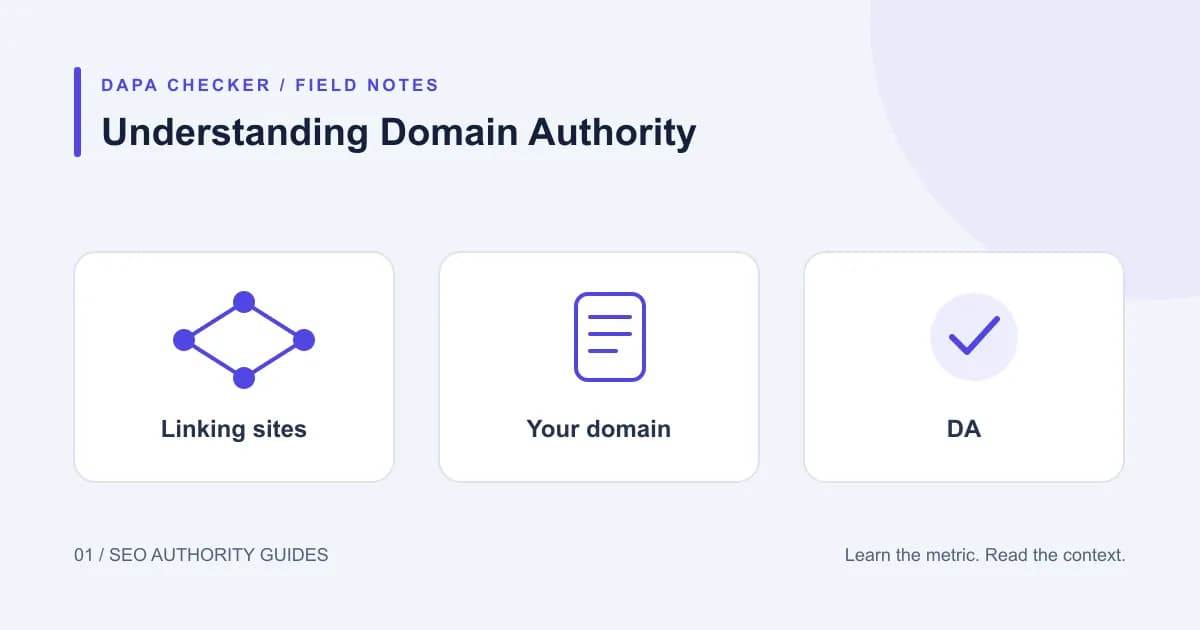
A whole-domain view
Link data
Moz discovers links pointing to your website.
Relative strength
Its model compares your link profile with other domains.
Domain Authority
The result is a comparative score on a 1–100 scale.
Is Domain Authority a Google ranking factor?
No. Domain Authority is a third-party metric, and Google has said many times that it does not use it. Google's own systems look at links, content, relevance and many other signals, and Moz has no access to how Google weighs them.
DA is still useful because it correlates with ranking ability. Sites with stronger link profiles tend to rank for more competitive terms. A DA score summarizes that link strength in one number you can compare quickly.
Domain Authority vs Page Authority vs Domain Rating
Domain Authority scores a whole domain. Page Authority scores one URL with the same Moz model. Domain Rating is Ahrefs' separate domain score built from Ahrefs' own link index.
- DA: whole domain, Moz index, 1 to 100.
- PA: single page, Moz index, 1 to 100.
- DR: whole domain, Ahrefs index, 0 to 100.
The numbers for the same site are usually close and rarely identical, because each company crawls the web differently. Our guide to DA vs PA vs DR covers when to use each one.
What is a good Domain Authority score?
A good Domain Authority score is one that is equal to or higher than the sites you compete with for the same keywords. There's no fixed target. A DA 25 can win a local plumbing niche, while a DA 50 can struggle in personal finance.
As a rough guide to what each range usually looks like:
- DA 1 to 15: new sites and sites with few external links. Most sites under a year old sit here.
- DA 15 to 30: established small sites with a modest, real link profile.
- DA 30 to 50: strong niche sites, usually several years old with steady link growth.
- DA 50 to 70: well-known publishers and category leaders.
- DA 70 and above: major platforms, national media and household brands.
If your site is brand new, expect a low number for a while. Our guide to Domain Authority for new websites covers realistic timelines.
Why Domain Authority matters for SEO decisions
Domain Authority matters because it gives you a fast, consistent way to compare link strength between sites. That helps with decisions that would otherwise take hours of backlink research.
- Competitor benchmarking. Compare your DA with the 3 to 5 sites that rank above you. A gap of 20 points usually means you need more links, not just better content.
- Link prospecting. Sort a list of 200 outreach targets by DA to decide where to spend time first.
- Tracking progress. Check your own DA monthly. A steady climb over a year shows your link building is working.
- Buying or valuing a site. DA is one quick input when judging an expired domain or a website for sale.
Limits of Domain Authority
Domain Authority has blind spots, and knowing them keeps you from making bad calls.
- It ignores content and relevance. A DA 60 recipe site gives little topical value to a cybersecurity blog.
- It can be inflated. Link networks and expired domains can push DA up without real traffic behind it. Check traffic and Spam Score before trusting a high number.
- It lags. New links can take weeks to show up in the index.
- It moves with the index. Scores can shift after Moz updates its data. Our article on why Domain Authority drops explains the common causes.
How to check your Domain Authority
You can check Domain Authority for free by entering a domain into our DA PA checker. You'll see DA, Page Authority, Domain Rating and Spam Score together, with no signup. Each number is labeled with its source, so you know whether it came from Moz, Ahrefs or our estimate. For a list of sites, use the bulk domain authority checker.
When you're ready to raise your score, our list of ways to increase Domain Authority is the next step.
Frequently asked questions
What is Domain Authority in simple terms?
Domain Authority is a 1 to 100 score from Moz that estimates how strong a website's backlink profile is compared with other sites. Higher scores suggest a better chance of ranking.
Does Google use Domain Authority?
No. Google does not use Moz's Domain Authority in its rankings. DA is an outside estimate that tends to correlate with ranking ability.
How often does Domain Authority update?
Moz refreshes scores as its link index updates, so DA can change within weeks. Large model updates can shift many sites at the same time.
Can I raise my Domain Authority quickly?
Not safely. DA rises when more relevant, trusted domains link to you, which usually takes months. Fast tricks tend to add spam signals.
Conclusion
Domain Authority is a Moz score that summarizes backlink strength on a 1 to 100 scale. It is useful for comparing sites and tracking progress, and Google does not use it to rank pages.
Use DA next to your competitors' scores, real traffic and relevance. Check yours with the free checker, then work on the links that move it.