October 24, 2026 · 5 min read
What Is Spam Score? How Moz Calculates It and When to Worry
Spam Score is a Moz metric, shown as a percentage, that estimates how many sites with features similar to yours have been penalized or banned by Google. A Spam Score of 5% means few similar sites were penalized. A Spam Score of 70% means most of them were.
Spam Score describes risk, not guilt. A high number doesn't prove a site is spam, and Google doesn't use it. It tells you where to look harder before you link to a site, buy one or accept links from it.
What Spam Score measures
Spam Score measures how closely a domain resembles sites that Google has penalized. Moz studies a large set of penalized and banned sites, finds the features they share, then checks every domain in its index for the same features.
Moz describes the metric on its Spam Score help page. The score applies to whole domains (subdomains get their own), and it updates as Moz recrawls the site.
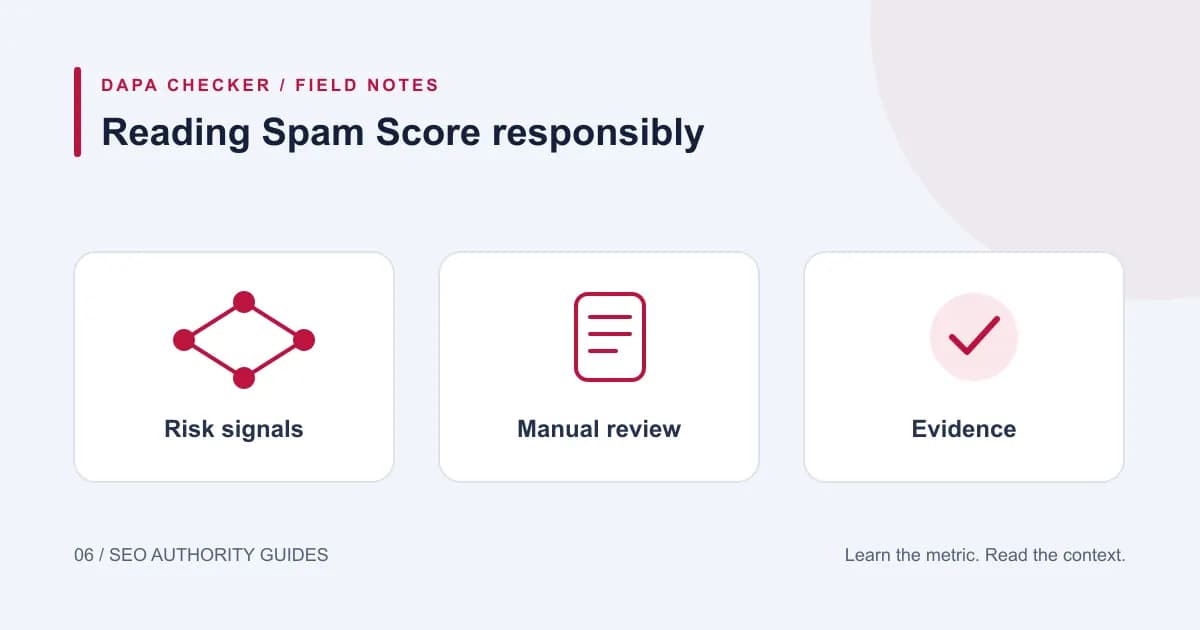
Visual guide
A signal to investigate
Read the source
Distinguish Moz Spam Score from a locally estimated risk score.
Inspect the site
Review content, link patterns and the site's actual purpose.
Confirm the issue
Check Search Console for manual actions on sites you own.
How Spam Score works
The process behind a Spam Score has 4 parts:
- Collect penalized sites. Moz identifies sites that Google has penalized or removed from results.
- Find shared features. A machine learning model learns which site and link features are common among those sites.
- Check each domain. Every domain in Moz's index is scored against those features.
- Report a percentage. The result is the share of sites with similar features that were penalized, from 1% to 100%.
Features that tend to raise the score include thin content, very few branded searches, a link profile dominated by low-quality domains, and a large number of outbound links relative to content.
What is a good Spam Score?
A good Spam Score is anything in Moz's low range, 1% to 30%. Moz groups scores into 3 bands:
- Low (1% to 30%): normal for most legitimate sites.
- Medium (31% to 60%): worth a manual look before linking or buying.
- High (61% to 100%): shares many traits with penalized sites. Check carefully and expect problems.
New and small sites sometimes land in the medium band only because they have few links and little brand search. That's why the score needs context.
Spam Score vs Domain Authority
Spam Score estimates risk, while Domain Authority estimates link strength. A site can have a high DA and a high Spam Score at the same time, which is a common pattern for link farms and expired domains rebuilt to sell links.
Read the two together. High DA with low Spam Score and real traffic is a good sign. High DA with high Spam Score and no traffic is a warning. Our guide to what Domain Authority is explains the other half of the picture.
Why Spam Score matters
Spam Score matters because links from risky sites waste money and can add risk under Google's link spam policy. It gives you a fast first check when you're vetting dozens of sites.
Common uses:
- Link prospecting: screen outreach and guest post targets before you contact them.
- Buying a domain: spot expired domains with a spammy past.
- Auditing your own site: a rising score can mean you're attracting low-quality links or your content has thinned out.
Our full checklist for evaluating backlink quality uses Spam Score as one of 6 checks.
How to lower your Spam Score
You lower Spam Score by removing the features that make your site look like penalized sites. There's no direct way to edit the number.
- Improve thin pages. Expand, merge or remove pages with little original content.
- Earn better links. Links from relevant, trusted sites dilute the weight of weak ones over time.
- Stop buying low-quality links. They add the exact features the model watches for.
- Add trust pages. Clear about, contact and policy pages are normal on real businesses and missing on many spam sites.
- Build your brand. More people searching your brand name is a strong sign of a real business.
Disavowing links in Google Search Console does not change Moz's Spam Score. The disavow file is read by Google only.
How to check Spam Score
You can check Spam Score for free with our spam score checker, which also shows DA, PA and DR. When Moz data is available, we show Moz's own score and label it. When it isn't, we show an estimate based on domain age, public blocklists, HTTPS and other signals, and we label it as an estimate. The methodology page explains exactly how.
Frequently asked questions
Does Google use Spam Score?
No. Spam Score is a Moz metric. Google uses its own spam detection systems and does not read Moz scores.
What Spam Score is too high?
Moz treats 61% and above as high. Sites between 31% and 60% deserve a manual review before you link to or buy them.
Why is my new site's Spam Score high?
New sites often have few links and little brand search, which some penalized sites also have. The score usually falls as the site earns real links.
Does a high Spam Score mean a site is penalized?
No. It means the site resembles penalized sites. Check Google traffic and the site itself before deciding.
Conclusion
Spam Score is Moz's percentage estimate of how many similar sites were penalized by Google. Under 30% is low risk, and above 60% needs a careful look.
Read it next to Domain Authority and real traffic, and never treat it as proof on its own.